The site is currently undergoing maintenance. We apologize for the inconvenience.


- Home
-
For students
- Class schedule
- Class Schedule
- Employment
- Student self-government
- Student Organizations
- Student Committee
- Elective Courses
- Instructions
- Campus Building Plan
- Non-formal education
- Student Science
- Practice
- Department of Military Training
- Tuition and dormitory fees
- Moodle educational platform
- Instructions
- PS - Performance Journal
- For applicants
- Activities
- About NUWEE
Results of the state attestation of scientific fields at NUVHP
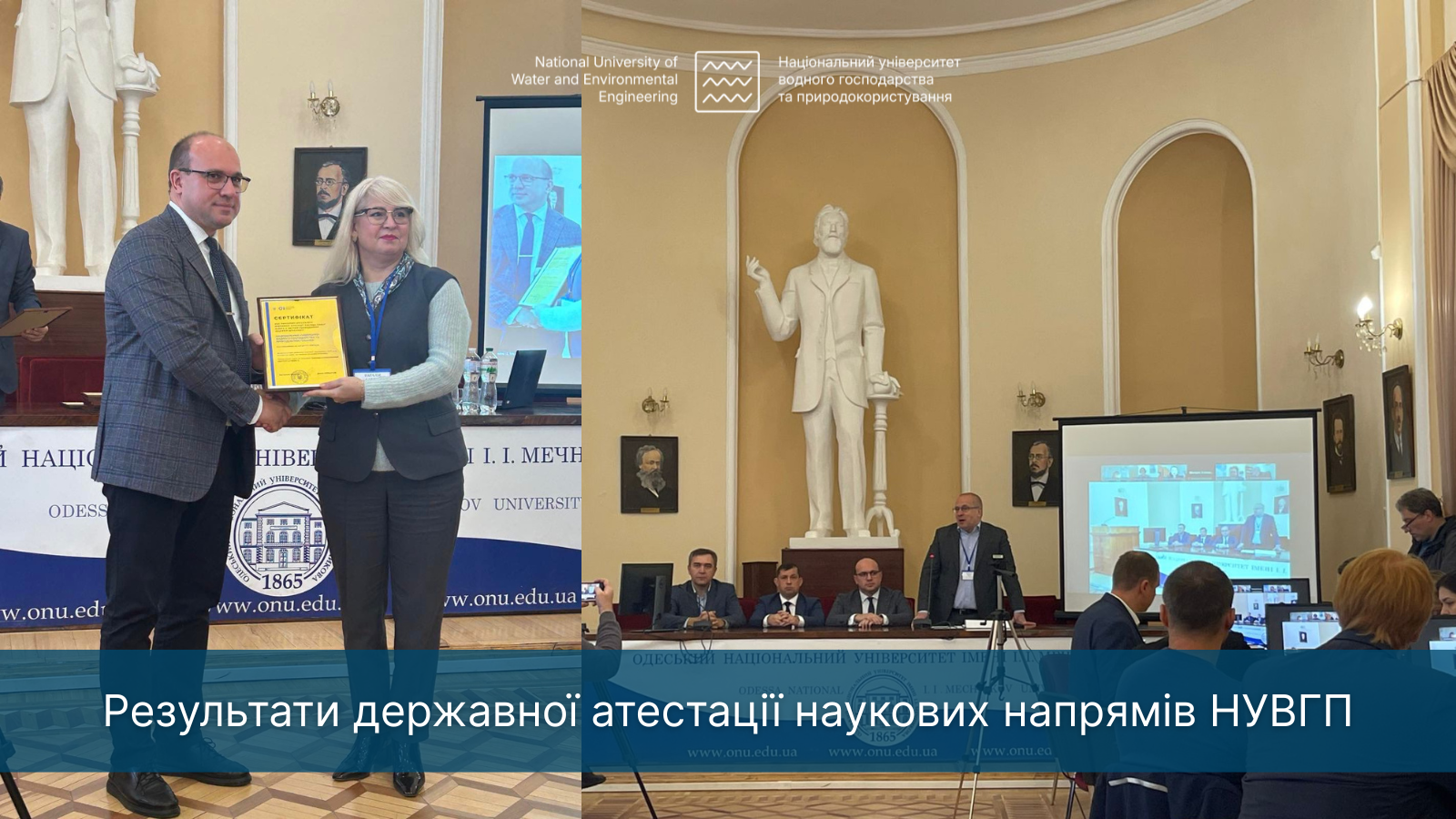
Vice-Rector for Research and International Relations Natalia Savina participated in the off-site meeting of the Executive Committee of the Council of Vice-Rectors for Research at the Ministry of Education and Science, which took place at the Odesa National University named after Mechnikov.
Representatives of leading higher education institutions, research institutions of Ukraine, research institutes, authorities, and international partners were invited to Odesa.
At the event, Deputy Minister of Education and Science of Ukraine Denys Kurbatov presented the results of the state attestation and announced the ratings of higher education institutions and research institutions in terms of conducting research activities.
The attestation was carried out in two areas of research: natural sciences and mathematics, and engineering and technology.
Thus, according to the results of the state attestation of research areas in higher education institutions, NUWGP was classified in group 'A' for the 'Engineering and Technology' direction and in group 'B' for the 'Natural Sciences and Mathematics' direction.
The results testify to the high level of the university's research activities, the impact of its developments on the advancement of cutting-edge research, technologies, and the economy of the country.
It should be noted that the state attestation since last year is the basis of the new system of science funding. The Cabinet of Ministers of Ukraine has introduced an updated system of state attestation for universities and research institutions, developed based on the best practices of Great Britain, Germany, and Poland.
The state will invest the most funds in the best research institutes and universities, as well as in research that aligns with its main priorities.
The evaluation covers both quantitative indicators (publications, citations, funding, international cooperation) and a qualitative analysis of the impact of research on science, economy, defense, and society.
The formula for the distribution of funds includes not only the results of the attestation but also the volume of attracting off-budget funds (from business, international grants); the percentage of young researchers in the institution;
the scale of the institution (number of academic and research staff); the quality of publications (quartile Q1); the support coefficient for frontline and border territories.
Funds will be allocated to departments and laboratories based on their contribution to the attestation results.
Starting from 2026, the updated funding model will be extended to other scientific areas, and universities will fully transition to the new basic funding model.
Natalia PARKHOMCHUK,
Public Relations Department