The site is currently undergoing maintenance. We apologize for the inconvenience.

- Home
-
For students
- Class schedule
- Class Schedule
- Employment
- Student self-government
- Student Organizations
- Student Committee
- Elective Courses
- Instructions
- Campus Building Plan
- Non-formal education
- Student Science
- Practice
- Department of Military Training
- Tuition and dormitory fees
- Moodle educational platform
- Instructions
- PS - Performance Journal
- For applicants
- Activities
- About NUWEE
Students of the NUWGP specializing in "Water Bioresources and Aquaculture" gain practical experience through the Erasmus+ project #AFISHE.
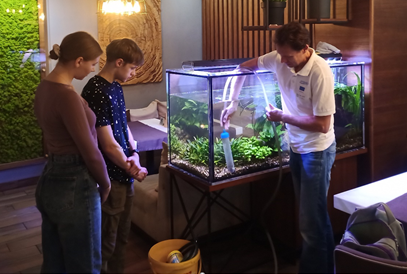
Part of the practical classes in the discipline of 'Decorative Aquaculture', included in the updated curriculum for Master's preparation, takes place with students visiting aquariums located in public establishments. The presence of an aquarium in the interior of a room creates a charming atmosphere that allows a person to gain aesthetic pleasure, relieve stress, and at least for a moment distract from everyday problems. And, of course, a corner of the living aquatic world located in the hotel lobby or café hall will beautify the establishment and provide additional pleasant impressions for guests.
Aquariums can also be seen in popular hotel-restaurant complexes in Rivne, where professional cuisine, excellent conditions for rest for travelers or residents of the city, as well as locations for holding business meetings or festive events are successfully combined: gastro-salon 'GUSTO» https://www.gusto.rv.ua/', hotel-restaurant complex 'Aivengo'https://www.aivengo.rv.ua/', hotel-restaurant complex 'OTTO» https://otto.rv.ua/'. During the implementation of the Erasmus+ project#AFISHE developed partnerships with these establishments.
Accordingly, for Master's students specializing in 'Water Bioresources and Aquaculture', studying such a subject is relevant and interesting from the perspective of future career. And now, during their studies under the updated Master's program, students have the opportunity to acquire practical skills in aquarium design development, carrying out regulatory work in exhibition aquariums, servicing the main technical equipment of aquariums, and showcases for seafood sales. Professor of the Department of Water Bioresources Serhiy Konontsev, who teaches the discipline 'Decorative Aquaculture', underwent specialized training under the project#AFISHE. During this period, European colleagues from the University of Porto (Portugal), University of Dubrovnik (Croatia) and the Slovak Agricultural University in Nitra (Slovakia) organized professional training for partners from Armenia and Ukraine in many areas of aquaculture, fish farming, and seafood processing.
Currently, Serhiy Konontsev is passing on the experience gained from partners in the AFISHE project from Portugal to students, as the locations for the training in this discipline were the aquarium center of the networkSeaLifein the city of Portohttps://www.visitsealife.com/porto/en/and the aquacomplex of the Coastal Research Station "ELA» https://fundacao-ela.pt/estacao-litoral-da-aguda/ela/.
Aquaristics, in addition to significant socio-economic importance, must play a key role in forming ecological awareness among the youth. Therefore, most exhibition centers and aquariums have designated areas where children are taught from a young age not to pollute the environment and to understand the catastrophic consequences of careless attitudes towards the planet we live on. In particular, one of the lecture sessions is dedicated to this aspect in the preparation of masters. Thus, the introductory part of the guide on "Decorative Aquaculture" includes a saying from the outstanding Japanese artist and one of the most famous aquaristsXXof the century, aquarist Takashi Amano:“People are young aliens on our old planet, which has crossed its fourth billion, and these young ones have already managed to pollute the once clean water, painting the green color of untouched meadows and fields in all the colors of the rainbow. In the attempt to get rich, people increasingly destroy nature. A good heart cannot grow in a landfill. We must remember that we can either live in nature or not live at all. Only by creating and maintaining a beautiful natural aquarium does a person understand the complex interrelationship that exists between all forms of life: plants, fish, microorganisms, and humans. Wealth and beauty come from harmony, from balance. The aquarium is a great teacher of this truth.”