The site is currently undergoing maintenance. We apologize for the inconvenience.

- Home
-
For students
- Class schedule
- Class Schedule
- Employment
- Student self-government
- Student Organizations
- Student Committee
- Elective Courses
- Instructions
- Campus Building Plan
- Non-formal education
- Student Science
- Practice
- Department of Military Training
- Tuition and dormitory fees
- Moodle educational platform
- Instructions
- PS - Performance Journal
- For applicants
- Activities
- About NUWEE
Training of non-teaching staff within the #AFISHE project
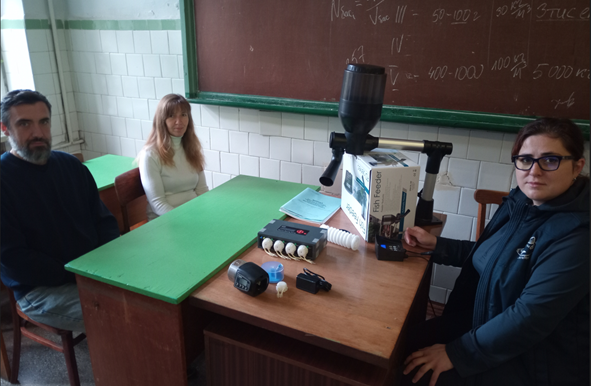
A two-week training for non-teaching staff has begun at NUVHP under the project#ErasmusPlus #AFISHE'Development of Education in Aquaculture and Fisheries for the Green Course in Armenia and Ukraine: from Education to Ecology'. The main goal of the training is to prepare qualified support staff for work in the integrated multitrophic aquaculture (IMTA) laboratory established under this project at our university.
Instructors (trainers) – entrepreneurs in the field of aquaculture and fisheries: individual entrepreneur Targoniy V.M. – training in the organization and production processes on the feed production line, LLC 'Laursen Aquaculture' – training in maintaining water parameters and servicing laboratory equipment.
The trainees include the head of the educational laboratories of the Department of Land Management, Cadastre, Land Monitoring, and Geoinformatics Roman Muzyka and the laboratory assistant of the Department of Aquatic Bioresources Oksana Ryzhенко. The training sessions are attended by university staff who will be involved in the activities of the IMTA laboratory according to their specialization.
On October 21-22, 2024, introductory classes took place, dedicated to the main aspects of technical equipment for fish farms operating on the principle of recirculating systems, and the analysis of the main parameters of the aquatic environment that need to be monitored and maintained within a specified range.
The classes were conducted byAnastasia Horetska– a representative of the fish farming enterprise"Laursen Aquaculture", which specializes in the breeding of catfish and also has experience in tilapia and pangasius catfish farming. Anastasia Horetska explained which indicators of the aquatic environment are constantly monitored at the enterprise"Laursen Aquaculture" and outlined the most common problems with water quality and diseases that arise during the breeding and incubation of catfish eggs. On the second day of the training, the participants were introduced to automated fish feeding systems and dispensers for adding fertilizers and reagents into the integrated aquaponics system. Using examples of automatic feeders for fish of various designs, skills were acquired in setting up automated fish feeding under different conditions. Additionally, according to the training program, participants became familiar with the designs of the main pumping equipment, recommendations for their selection, installation, and periodic maintenance.