The site is currently undergoing maintenance. We apologize for the inconvenience.


- Home
-
For students
- Class schedule
- Class Schedule
- Employment
- Student self-government
- Student Organizations
- Student Committee
- Elective Courses
- Instructions
- Campus Building Plan
- Non-formal education
- Student Science
- Practice
- Department of Military Training
- Tuition and dormitory fees
- Moodle educational platform
- Instructions
- PS - Performance Journal
- For applicants
- Activities
- About NUWEE
Project AFISHE: Opening a Laboratory for Integrated Multi-Trophic Aquaculture
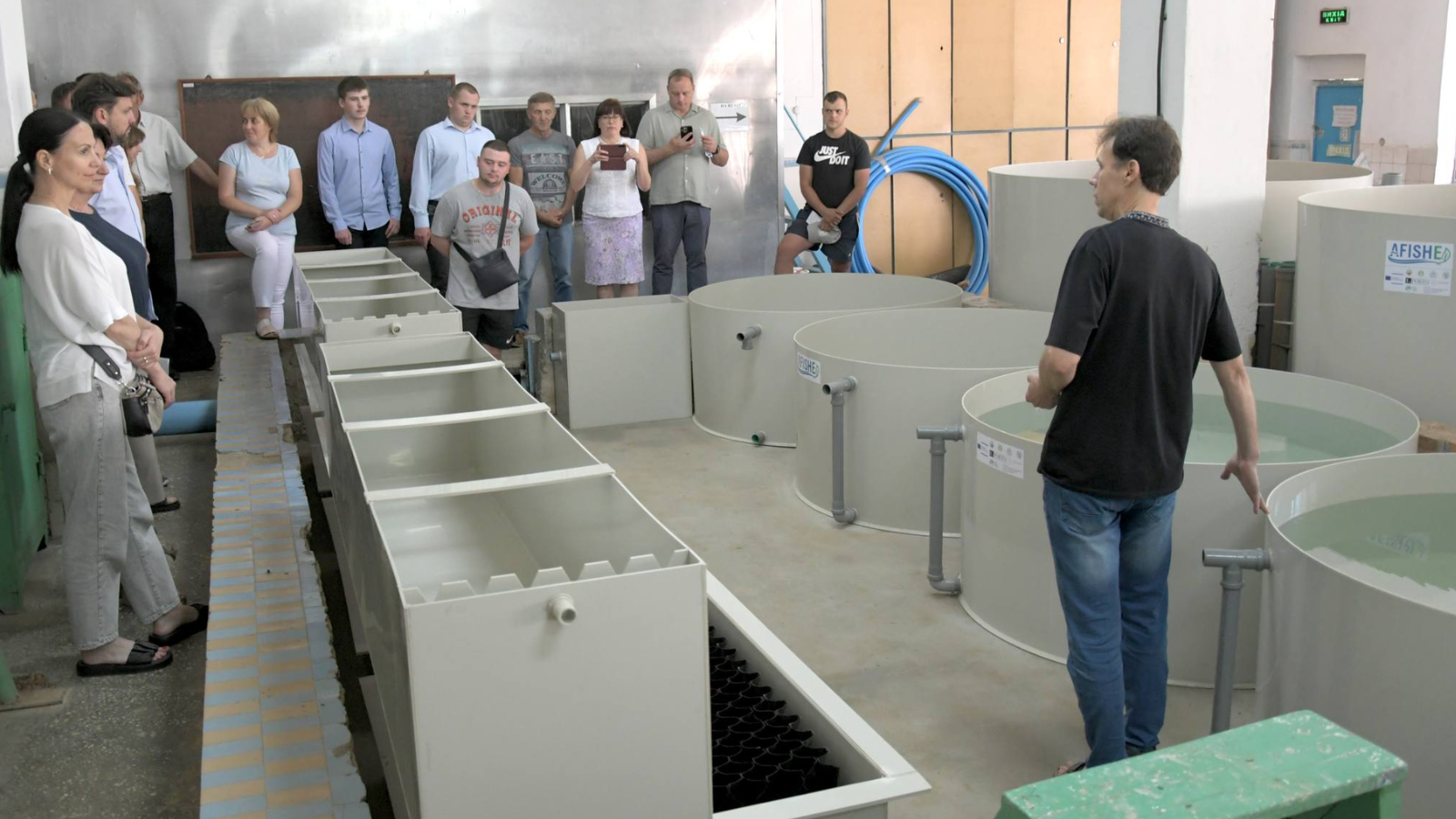
On June 27, 2024, the official opening of the integrated multitrophic aquaculture laboratory took place at the National University of Water Management and Nature Management. The equipment for the laboratory was purchased with grant funds as part of the Erasmus+ KA2 AFISHE project "Development of Education in the Field of Aquaculture and Fishing for the Green Deal in Armenia and Ukraine: From Education to Ecology."
The event was attended by the Vice-Rector for Research and Educational Work V.S. Soroka; the Director of the Institute of Agroecology and Land Management A.M. Prishchepa; the Director of the Educational and Scientific Institute of Energy, Automation, and Water Management A.P. Safonik, faculty and researchers from the NSC, students majoring in "Water Bioresources and Aquaculture" in full-time and integrated forms of study, as well as invited representatives from businesses in Rivne and Kyiv regions.
The laboratory will serve as a practical base for students who will be studying the updated master's program in "Water Bioresources and Aquaculture" at NUVHP next year. In addition to cultivation ponds of various shapes and sizes, the grant project has provided for the purchase of pumping and aeration equipment, facilities for mechanical and biological water purification, equipment for thermal regulation, dissolved oxygen content control, and automated fish feeding.
The laboratory base will also enhance the level of practical training at the bachelor's level in this specialty. As part of the collaboration with LLC "SCIENTIFIC PARK."INNOVATIVE TECHNOLOGIES Rivnenska Oblast"Research has already begun on the technological aspects of growing promising aquaculture species in recirculation systems, determining rational feeding parameters and physicochemical indicators of water, and developing hardware for water quality restoration."
In the future, the laboratory will promote the intensive development of modern aquaculture technologies, as it is designed not only for training students but also for conducting training sessions on growing aquaculture species in recirculating aquaculture systems (RAS) for all interested parties. The feed production line, which will also be part of the laboratory's resources, will enable the farm to provide self-produced feed, conduct assessments of the effectiveness of different formulations, and perform comparative studies of various types of feed.