The site is currently undergoing maintenance. We apologize for the inconvenience.


- Home
-
For students
- Class schedule
- Class Schedule
- Employment
- Student self-government
- Student Organizations
- Student Committee
- Elective Courses
- Instructions
- Campus Building Plan
- Non-formal education
- Student Science
- Practice
- Department of Military Training
- Tuition and dormitory fees
- Moodle educational platform
- Instructions
- PS - Performance Journal
- For applicants
- Activities
- About NUWEE
Participation in the round table "Current Directions of Student Science"
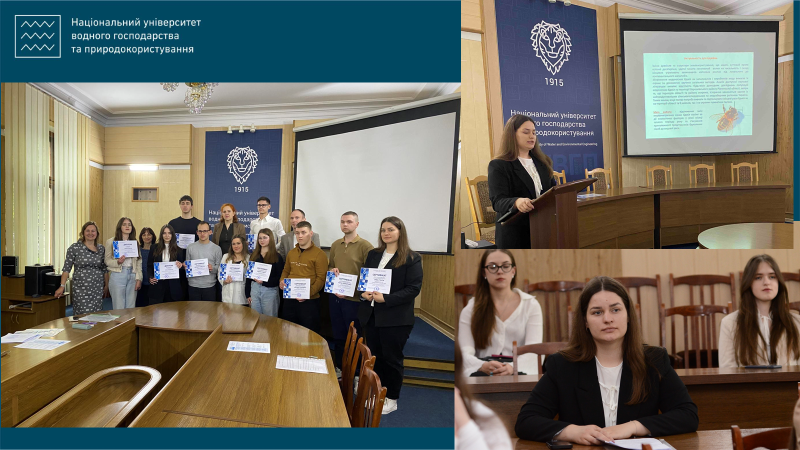
Huntik Iryna Ivanivna, a second-level student in Ecology, represented the students of the Institute of Agroecology and Land Management at an event during the Science Festival of NUWGP. She participated in the round table "Current Directions of Student Science," which took place in the conference hall of the main university building within the annual "Science Festival," which has been bringing together talented student youth from various educational and scientific institutes for over 10 years. The event aimed to present the results of student scientific research, discuss current scientific issues, and form an active academic community of young researchers.
During the event, Huntik Iryna delivered a presentation titled "The Influence of Environmental Factors on Changes in the Morphological Characteristics of Bees," in which she presented the results of her own research on the interrelationship between ecological conditions and the morphological features of honeybees. The presentation emphasized the significance of natural and anthropogenic factors, particularly the impact of climate change, environmental pollution, and urbanization processes on bee population development.
It is important to highlight that Huntik Iryna is a prizewinner of an international competition, which confirms her high level of scientific training and her ability to engage in solving complex practical problems.
During the event, participants presented a wide range of relevant research - from engineering and legal issues to questions of ecology, digitalization, and sustainable development. This confirmed that student science is diverse, modern, and has a clear practical orientation. The event concluded with the summation of the essay competition "Student Science: Formality or Superpower?" during which the best works were recognized and winners were awarded.
Participation in the round table provided an opportunity to discuss research results with the scientific community, receive professional comments and recommendations, and also engage in discussions about current trends in the development of student science.