The site is currently undergoing maintenance. We apologize for the inconvenience.


- Home
-
For students
- Class schedule
- Class Schedule
- Employment
- Student self-government
- Student Organizations
- Student Committee
- Elective Courses
- Instructions
- Campus Building Plan
- Non-formal education
- Student Science
- Practice
- Department of Military Training
- Tuition and dormitory fees
- Moodle educational platform
- Instructions
- PS - Performance Journal
- For applicants
- Activities
- About NUWEE
Educational and Scientific Institute of Agroecology and Land Management

General Information
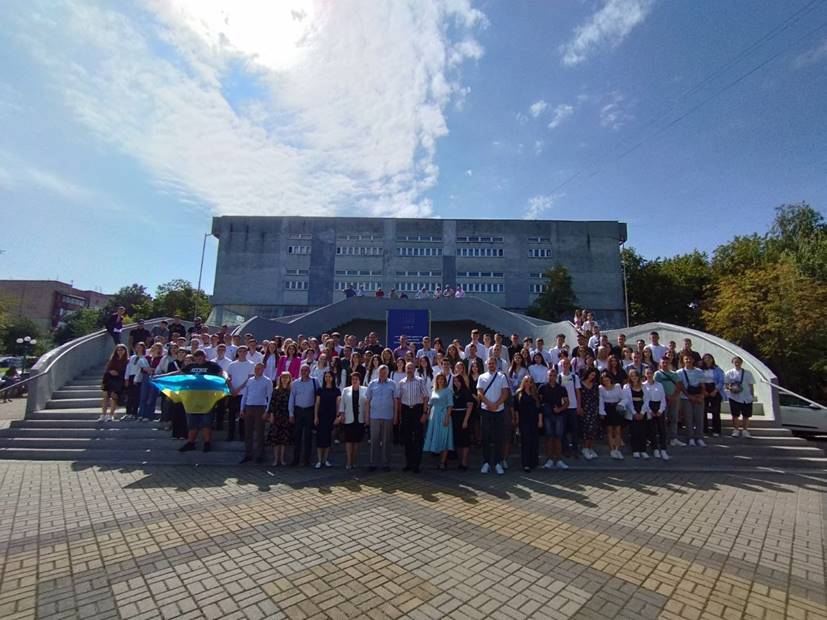
The Educational and Scientific Institute of Agroecology and Land Management (ESIAML) was established in 2013. It consists of the Faculty of Ecology and Natural Resource Management (FENRM) and the Faculty of Land Management and Geoinformatics (FLMG), which were formed as a result of the division of the Faculty of Ecology and Land Management in 2003.
The Faculty of Ecology and Land Management (FELM) was established by the decision of the Academic Council of the Ukrainian State Academy of Water Management on May 29, 1995. The faculty included the departments of Ecology, Meliorative Soil Science and Agriculture, Chemistry, Foreign Languages, and Geodesy.
The first dean of the faculty (1995-2006) was Doctor of Agricultural Sciences, ProfessorMykola Oleksandrovych Klymenko.The result of the work of the team he led was the licensing and accreditation of new modern specialties.
After the division of FELM in 2003, the Faculty of Ecology and Natural Resource Management was headed by Professor M.O. Klymenko (2003-2006) and Doctor of Agricultural Sciences, Professor S.I. Veremeyenko (2006-2013), while the deans of the Faculty of Land Management and Geoinformatics were Doctor of Technical Sciences, Professor P.H. Chernyaga (2003-2009) and Candidate of Technical Sciences, Associate Professor A.H. Lishchynsky (2009-2013).
Since 2016, the director of the Educational and Scientific Institute of Agroecology and Land Management is Doctor of Agricultural Sciences, ProfessorAlla Mykolaivna Pryshchepa.
Today, the ESIAML includes departments: Ecology, Environmental Protection and Forestry Technology; Land Management, Cadastre, Land Monitoring and Geoinformatics; Geodesy and Cartography; Agrochemistry, Soil Science and Agriculture; Aquatic Biological Resources; Chemistry and Physics; Tourism.
Thirteen doctors of sciences, professors, and 62 candidates of sciences, associate professors work at the institute's seven departments.
The institute has ten educational laboratories; fifteen specialized classrooms; a scientific electronic library; two press centers for holding press conferences and professional training of specialists.
Considering the high level of organization of the educational process, the institute prepares specialists capable of solving ecology and natural resource management problems, conducting environmental monitoring, and developing scientifically justified land management projects for rational territory organization.
The institute trains specialists at the educational level of 'bachelor' in the following areas: ecology; environmental protection technologies; geodesy, cartography, and land management; agronomy; aquatic bioresources and aquaculture; tourism; hotel and restaurant management.
Also, the Institute of Environmental and Agricultural Sciences prepares specialists under the following master's educational and professional programs:
- Ecology
- Environmental protection technology
- Forestry
- Land management and cadastre
- Geoinformation systems and technologies
- Agrochemistry and soil science
- Aquatic bioresources
- Conservation, reproduction, and rational use of hydrobiological resources.
Since 2016, two departments of the Institute of Environmental and Agricultural Sciences (the Department of Agrochemistry, Soil Science, and Agronomy; the Department of Ecology, Environmental Protection Technologies, and Forestry) have been training candidates at the third level (PhDs) under the educational and scientific program 'Agronomy.' In 2021, an educational and scientific program for third-level candidates 'Ecology' was introduced at the institute.
The Department of Agrochemistry, Soil Science, and Agronomy has a scientific school led by Professor Stepan Tikhonovych Vozniuk, and the Department of Ecology, Environmental Protection Technologies, and Forestry has a scientific school led by Professor Mykola Oleksandrovych Klymenko.
A specialized academic council for the defense of candidate dissertations in the specialties 06.01.03 – agro-soil science and agrophysics, 03.00.16 - ecology (agricultural sciences) was opened and successfully operated until December 31, 2021 (the head of the council – Doctor of Agricultural Sciences, Professor Mykola Oleksandrovych Klymenko; deputy head of the council - Doctor of Agricultural Sciences, Professor V.S. Moshynskyi).
The Educational and Scientific Institute of Agroecology and Land Management has modern material and technical support for conducting the educational process, scientific research, and preparing competitive specialists in the labor market. To enhance practical training, there are 5 branches of departments functioning (2 branches of the Department of Agrochemistry, Soil Science and Agriculture, 2 branches of the Department of Tourism and Hotel-Restaurant Business, and 1 branch of Aquatic Bioresources). The institute has established an Employers' Council and a Graduates' Council that continuously monitor educational programs, provide internship bases, and contribute to the employment of graduates.
DEVELOPMENT CONCEPT OF THE EDUCATIONAL AND SCIENTIFIC INSTITUTE OF AGROECOLOGY AND LAND MANAGEMENT
The goal of the Educational and Scientific Institute of Agroecology and Land Management is to assist the university in obtaining the status of a self-governing (autonomous) research national university, which entails a comprehensive resolution of issues related to the modernization of the educational process in the context of sustainable development.
Prerequisites for the implementation of the concept:
- the use of existing competitive advantages and opportunities on one hand, and the neutralization of phenomena and factors leading to the creation of external and internal threats to its development on the other;
- improvement of the quality of the educational process by implementing the latest educational technologies and appropriate staffing;
- implementation of bachelor's, master's, candidate, and doctoral programs built on the principles of the best world experiences;
- deepening the study of foreign languages;
- organic combination of education with research work;
- selection of talented and gifted youth for education;
- promotion of investment search in the development of scientific research.
Research and innovation activities
The goal is to conduct a wide range of fundamental, applied, and exploratory research, implement highly effective master's training and higher qualification staff, and be a leader in organizing and developing innovative scientific and entrepreneurial activities. The profile of scientific research should be relevant and carried out in priority areas of science and technology development.
Tasks:
- development of fundamental and applied scientific directions carried out in priority areas;
- reorientation of the Institute towards effective commercialization of research and development results with the participation of Ukrainian and foreign subjects of innovative activity;
- development of the innovative educational sphere based on the integration of knowledge obtained during scientific research, experimental design, and innovative entrepreneurial work with modern educational technologies;
- formation of a wide mutually beneficial partnership of the Institute with Ukrainian and foreign universities, scientific and industrial organizations and companies;
- maximum possible involvement of students and faculty in research activities.
Restructuring and personnel management
The personnel policy is a component of the strategic policy of the Institute that allows aligning the personnel potential with accreditation requirements. The formation and implementation of the personnel policy are based on the principles of systemicity, innovation, and social protection of employees. The goal is to create a system for the formation, development, and management of the staffing of the Institute, possessing a high level of professionalism necessary to achieve objectives and corresponding to the goal of collective development.
Tasks:
- conduct systematic, targeted work on the selection and training of personnel, formation of a staff reserve;
- conduct regular and objective assessment of the labor and professional potential of the scientific and pedagogical staff and researchers of the Institute;
- improvement of the qualification enhancement system for scientific-pedagogical and scientific staff of the Institute by entering into bilateral long-term cooperation agreements with educational institutions in Ukraine and abroad, which will provide for mutual exchange of scientific literature, organization of joint scientific-practical conferences, exchange of lecturers, as well as their training in postgraduate and doctoral programs;
- assistance to Institute staff in the preparation and defense of dissertations for obtaining academic degrees of candidate and doctor of sciences;
- strengthening the motivation for educational, methodological, and research activities and stimulating the growth of professionalism among staff through moral and economic incentives.
International Activities
The aim of international cooperation is to expand long-term Institute programs for collaboration in student exchange, research activities, information technology exchange, and to strengthen the authority of NUVHP in the global community. Achieving international standards of education quality and scientific research is impossible without the implementation of the experience of leading foreign educational and research institutions into the educational process and the sphere of scientific activity of the Institute.
Tasks:
- participation in scientific-practical conferences, seminars, and exhibitions, as well as in the implementation of international projects and programs;
- creation of joint scientific centers, Institutes, and other associations with foreign partners to carry out educational and research programs, issuing students, postgraduates, and doctoral candidates relevant documents about their education;
- improvement of the quality of language training for students, scientific-pedagogical, and scientific staff of the university;
- activation of short and long-term participation of lecturers and students in training, internships, and qualification enhancement programs at foreign partner higher educational institutions, in summer school programs, and educational-cultural exchanges;
Social sphere and student life
The aim of the strategic development of the Institute is to raise the social status of educators and scientists, provide social protection for staff, students, and postgraduates.
Tasks:
- involvement of representatives from student self-government in organizing the educational and upbringing process at the Institute;
- strengthening the health of students and staff; organizing their treatment and health improvement, prevention and prophylaxis of diseases;
- support for privileged categories of the student community (with the provision of material assistance);
- health improvement for socio-economically vulnerable students;
- establishing cooperation between the Youth Social Service Center and medical institutions, educational institutions, and public organizations on issues of tuberculosis and substance abuse prevention, etc.;
- expansion of the role of student self-government in organizing the living conditions and daily life of students in dormitories;
- establishing permanent connections of the student council with the student self-government bodies of other higher educational institutions in Ukraine (exchange of experience, organization of joint trips, meetings, cultural, educational, sports, and other events);
- creating conditions for further creative growth of the University’s artistic collectives and obtaining the honorary title of 'people's' for the brass band, dramatic collective, and folk choir.
Material and technical base and financial support
Goal — preservation, continuous development, and renewal of the material and technical base to meet the needs of the educational, scientific, upbringing, and social processes, as well as financial support for the effective functioning of the university structure.
Tasks:
- attracting sponsorship funds for the development of the Institute;
- conducting landscaping of the Institute's territory;
- conducting repairs of classrooms, laboratories, and computer labs;
- improving living and socio-domestic conditions for students and teachers;
- ensuring energy savings;
- determining priority directions for the allocation of financial resources for the functioning and development of the Institute and NUVHP;
- training highly qualified personnel in accordance with the requirements of a research university;
- publishing textbooks, manuals, and methodological developments in accordance with accreditation requirements and education reform in the context of sustainable development;
- opening new specialties and specializations;
- repairing and equipping classrooms and laboratories;
- raising the qualification of teachers in accordance with accreditation requirements