The site is currently undergoing maintenance. We apologize for the inconvenience.

- Home
-
For students
- Class schedule
- Class Schedule
- Employment
- Student self-government
- Student Organizations
- Student Committee
- Elective Courses
- Instructions
- Campus Building Plan
- Non-formal education
- Student Science
- Practice
- Department of Military Training
- Tuition and dormitory fees
- Moodle educational platform
- Instructions
- PS - Performance Journal
- For applicants
- Activities
- About NUWEE
Leadership School on the topic "European Standards of Sustainable Development."
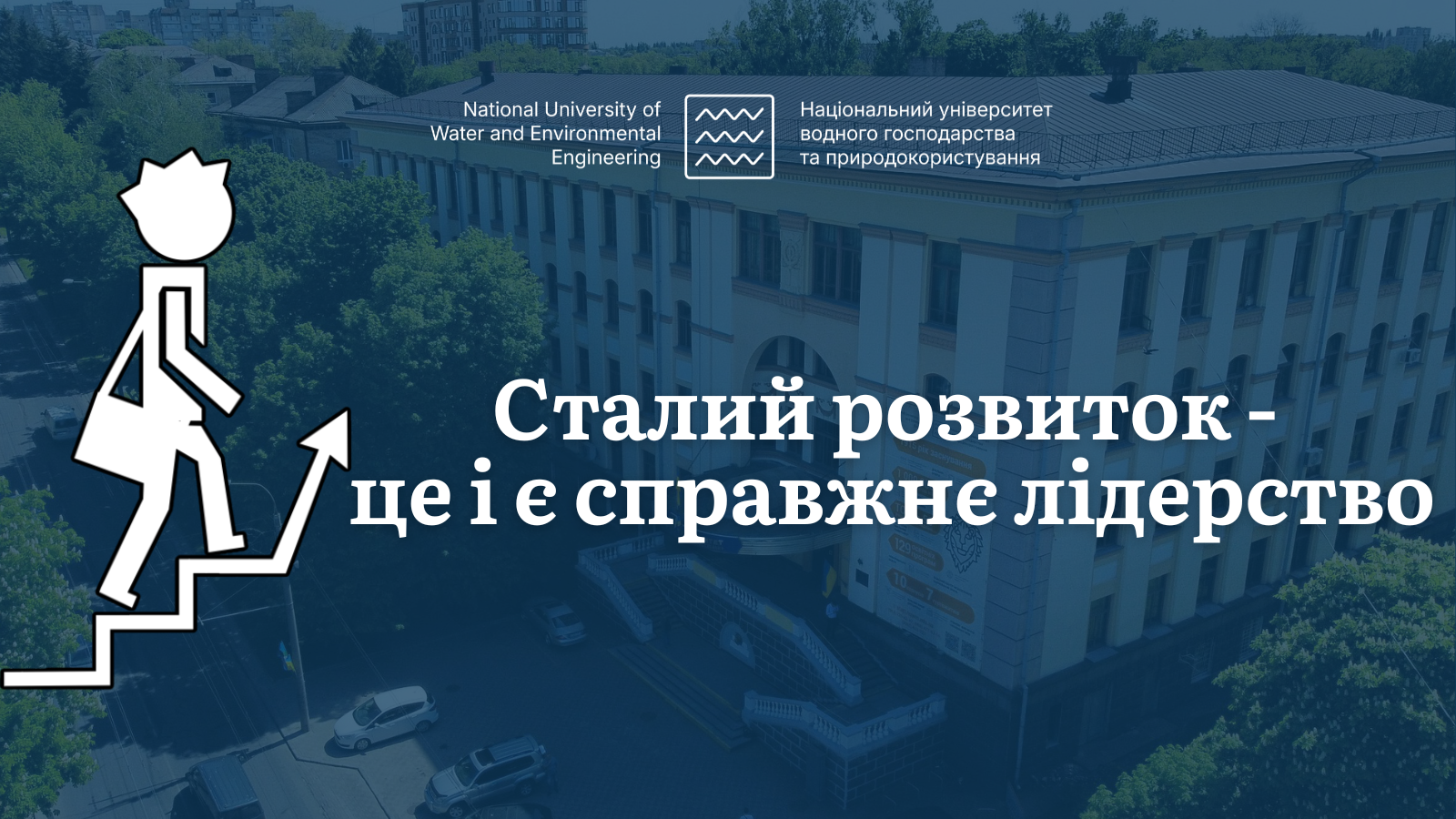
Online classes of the Leadership School on the topic 'European Standards of Sustainable Development' took place at the National University of Water Management and Nature Management.
The program united about 140 educational and scientific-pedagogical workers, including lecturers from the Institute of Water Management, and was aimed at implementing sustainable development principles in the educational process and modernizing the training of specialists. The project was led by the Vice-Rector for Scientific and Pedagogical Work Valerii Soroka. Within the Leadership School, key thematic areas were presented, including: 'Education for Sustainable Development' - Mykola Klymenko, Doctor of Agricultural Sciences, Professor, Honored Scholar, Head of the Department of Ecology, Environmental Protection Technologies and Forestry of NUWM; 'Integration of Sustainable Development Goals into Educational Programs as Part of Transforming Specialist Training in Response to Global Challenges' - Alla Pryshchepa, Doctor of Agricultural Sciences, Professor, Director of the Educational and Scientific Institute of Agroecology and Land Management.
The training combined theoretical preparation and practical tools. Participants mastered the basics of sustainable development, European reporting standards (ESRS/VSME), learned to analyze educational programs for compliance with the Sustainable Development Goals, and to use modern digital tools, including artificial intelligence, to update the content of disciplines.
Participants gained practical skills in analyzing educational programs for compliance with the Sustainable Development Goals and European reporting standards, and also mastered modern technologies, including AI tools and prompting. This allows for the effective updating of the content of educational disciplines and improving the processes of self-assessment of educational programs.
Reconsidering educational programs through the lens of sustainable development opens up new strategic opportunities for the university and strengthens its competitive positions in the educational services market. The integration of the twin transition approach - the combination of digital and green transitions - will contribute to the formation of a modern educational environment where teachers and students work together to address global challenges.
Updated educational programs, curricula, and specific educational components based on principles of digital maturity and sustainable development ethics will become an important foundation for training competitive specialists capable of ensuring balanced development in Ukraine.