The site is currently undergoing maintenance. We apologize for the inconvenience.


- Home
-
For students
- Class schedule
- Class Schedule
- Employment
- Student self-government
- Student Organizations
- Student Committee
- Elective Courses
- Instructions
- Campus Building Plan
- Non-formal education
- Student Science
- Practice
- Department of Military Training
- Tuition and dormitory fees
- Moodle educational platform
- Instructions
- PS - Performance Journal
- For applicants
- Activities
- About NUWEE
Summary of the Summer Camp at the University of Sustainable Development Eberswalde
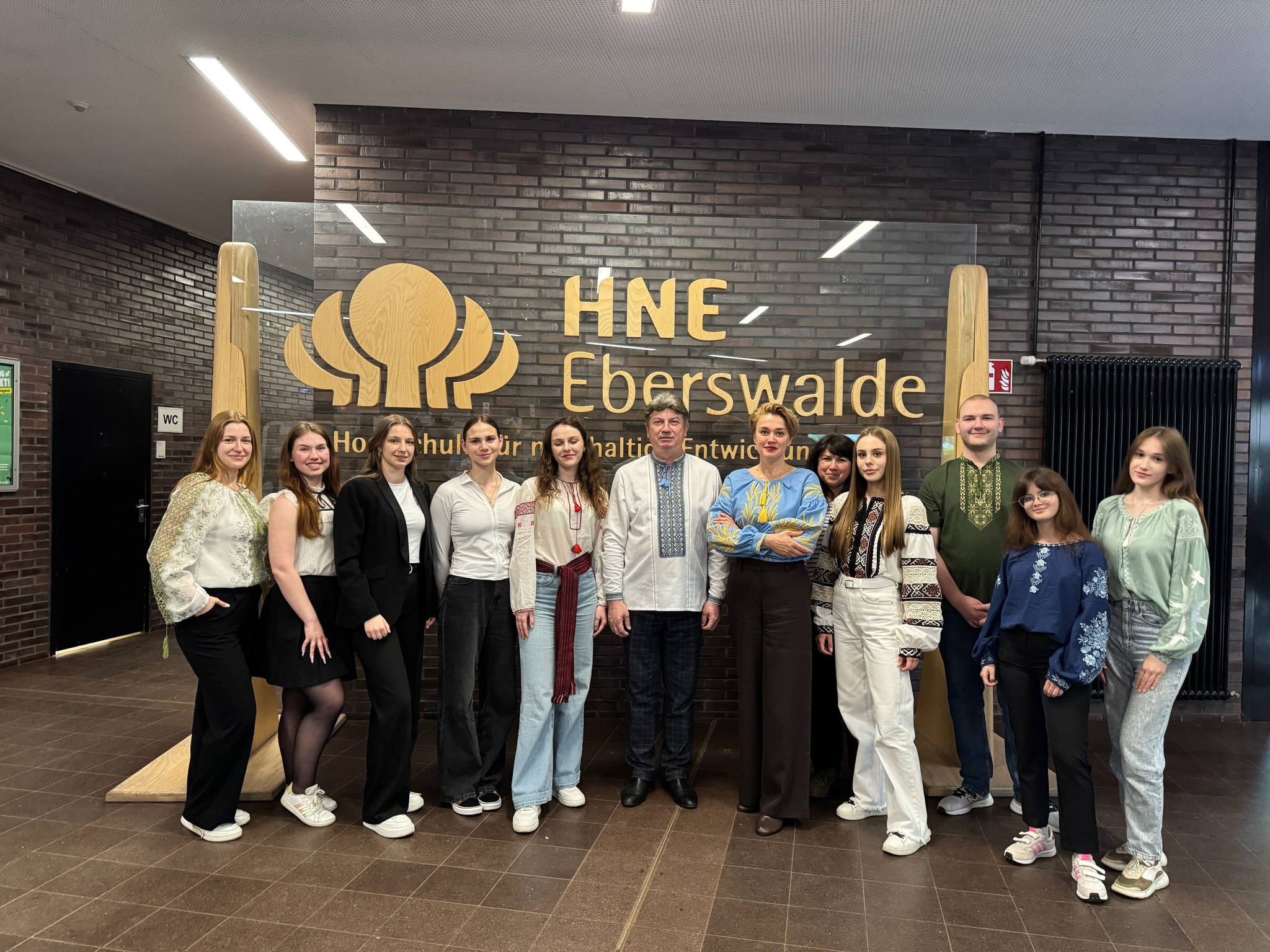
The second week of the Training Camp held at the Eberswalde University for Sustainable Development has concluded. Our student Dmytro Antoniuk specializing in Environmental Protection Technologies is a participant in this camp. The camp was organized as part of the pilot implementation of the course 'Nature-based', jointly developed by Ukrainian and German professors within the ConnectED network, as part of the 'ConnectED' project.
Throughout the week, students studied the topic 'Nature-based' through lectures, discussions, and numerous practical field excursions in the forests. Together with professors from the Eberswalde University for Sustainable Development (Hochschule für nachhaltige Entwicklung Eberswalde, HNEE), the National Forestry University of Ukraine (NFU of Ukraine),the National University of Life and Environmental Sciences of Ukraineand other partners, the students explored the principles of nature-based forestry, sustainable forest management, natural regeneration, forest ecosystem services, and the role of peatlands in climate and biodiversity conservation.
Teaching and field sessions were conducted by Professor Peter Spatgelf, Professor Vasyl Lavnyi, Dr. Oleksandr Soshenko, Professor Jan-Peter Mund, and Oliver Jennicher. Special attention was paid to the modern challenges of forestry in Ukraine amid the war, adapting forests to climate changes, and implementing nature-based forestry.
Field sessions in the forests of Eberswalde and Chorin were particularly valuable, where participants worked alongside local foresters, studying tree species, soil characteristics, forest development, and practical approaches to thinning and forestry management under climate change conditions.
An important part of the camp was the international academic exchange. Ukrainian and German students, teachers, and practitioners continuously discussed contemporary challenges in forestry, teaching methodologies, adapting education to European approaches, and the prospects for jointly developing new courses for Ukrainian universities.
This week was not just about learning. It became a space for cooperation, new acquaintances, professional development, intercultural dialogue, and a common search for solutions for the sustainable future of forests.