The site is currently undergoing maintenance. We apologize for the inconvenience.


- Home
-
For students
- Class schedule
- Class Schedule
- Employment
- Student self-government
- Student Organizations
- Student Committee
- Elective Courses
- Instructions
- Campus Building Plan
- Non-formal education
- Student Science
- Practice
- Department of Military Training
- Tuition and dormitory fees
- Moodle educational platform
- Instructions
- PS - Performance Journal
- For applicants
- Activities
- About NUWEE
Round Table "40 Years Since the Chernobyl Disaster: Environmental and Social Consequences, Modern Challenges"
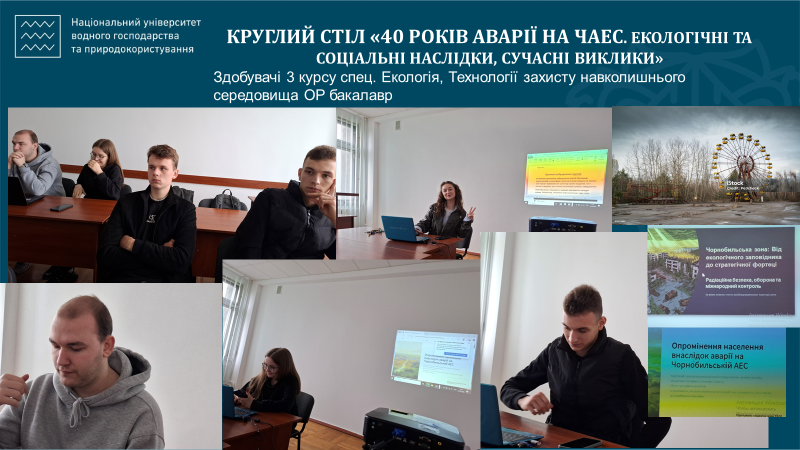
Students of the 3rd year majoring in 'Ecology' and 'Environmental Protection Technologies' within the framework of the Science Festival of NUWGP, in the study of the course 'Environmental Safety' (instructors: Professor Pryshchepa A.M., Associate Professor Budnik Z.M., Senior Lecturer Varzhel O.V.) and in honor of the 40th anniversary of the Chernobyl disaster held a round table on the topic: '40 years since the Chernobyl disaster. Environmental and social consequences, modern challenges'. On April 26, the 40th anniversary of the Chernobyl disaster at the Chernobyl Nuclear Power Plant was marked - one of the largest technological disasters in history, which caused long-term environmental, social, and medical consequences for Ukraine and the world.
During the round table, the causes of the Chernobyl disaster and its large-scale consequences for the environment and humans were discussed. Special attention was given to the impact of the disaster on the health of liquidators, the state of agriculture and forestry, as well as the long-term radiation contamination of the territories.
Modern risks for the population, issues of land use and management in the 30-kilometer exclusion zone, as well as the restoration of natural ecosystems and the functioning of the Chernobyl Radiation-Ecological Biosphere Reserve were discussed separately.
The participants of the round table emphasized the importance of continuous monitoring of the environmental state of the territories, the necessity of a scientifically-based approach to their restoration and preservation, as well as the significance of the Chernobyl disaster as a global lesson for humanity.
The disaster at Chernobyl remains one of the largest technological disasters in history, the consequences of which are still felt today. Studying it is extremely important for understanding environmental risks, forming ecological safety systems, and preventing similar tragedies in the future.