The site is currently undergoing maintenance. We apologize for the inconvenience.

- Home
-
For students
- Class schedule
- Class Schedule
- Employment
- Student self-government
- Student Organizations
- Student Committee
- Elective Courses
- Instructions
- Campus Building Plan
- Non-formal education
- Student Science
- Practice
- Department of Military Training
- Tuition and dormitory fees
- Moodle educational platform
- Instructions
- PS - Performance Journal
- For applicants
- Activities
- About NUWEE
Representatives of the Institute of Water Resources participated as experts in the hackathon for the development of community water infrastructure.
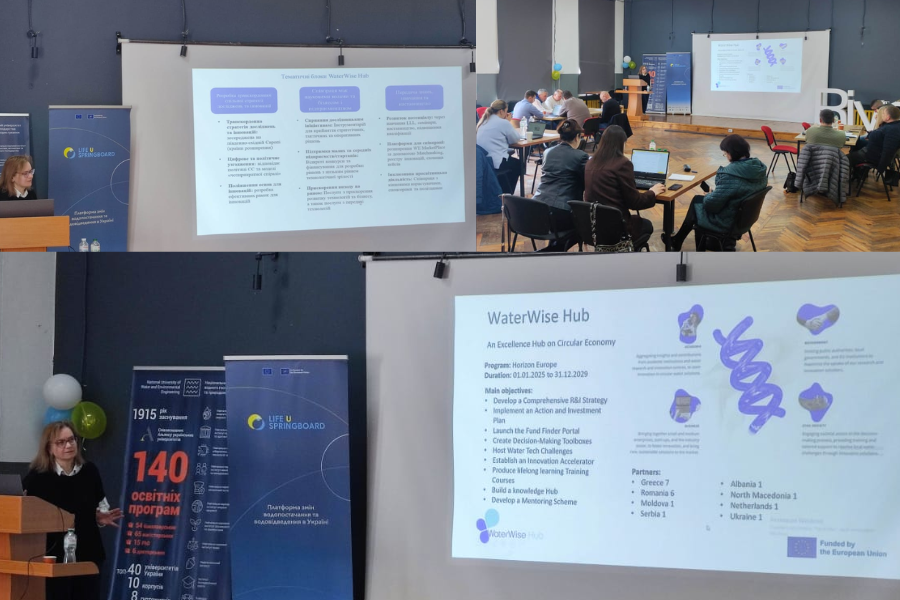
On April 28-29, 2026, a hackathon took place at the National University of Water Management and Nature Management"Climate-Oriented Resource-Saving Solutions", organized within the projectLIFE-U-SPRINGBOARD. The event brought together representatives of communities, municipal enterprises, water supply and sewage services, experts, and the scientific community to explore modern technological and management solutions to improve the efficiency of water infrastructure and the sustainable use of water resources.
Experts from the Educational and Scientific Institute of Agroecology and Land Management of NUWMP joined the hackathon –Alla Kucherova, head of the grant department, andIhor Statnyk, associate professor of the Department of Ecology, Environmental Protection Technology, and Forestry.
Participants included representatives of local governments, heads of municipal institutions from the Zdolbuniv, Rivne, and Kostopil communities of Rivne region, as well as the Turiy community of Lviv region, and engineers and ecologists from Rivneoblvodokanal and Zdolbunivvodokanal.
During the work with stakeholders,Alla Kucherovapresentedinternational grant project Horizon Europe 'The WaterWise Hub: An Excellence Hub on Water in the Circular Economy' (WWH), aimed at developing innovative approaches to water resource management and implementing the principles of circular economy in the water sector. Participants discussed opportunities for applying modern approaches to circular use of water and international experience for community development.
A separate practical component of the event was the workshop conducted byIhor Statnykonenvironmental impact assessment (EIA), during which participants learned about modern approaches to assessing the potential impact of project solutions on the environment and considering ecological aspects in the planning of water infrastructure development.
Over two days, participants worked on issues related to the modernization of water infrastructure, digitalization of water supply systems, and the implementation of resource-saving solutions. The results of the work were developed roadmaps, specific initiatives, and identified opportunities for further development and attracting funding.