The site is currently undergoing maintenance. We apologize for the inconvenience.


- Home
-
For students
- Class schedule
- Class Schedule
- Employment
- Student self-government
- Student Organizations
- Student Committee
- Elective Courses
- Instructions
- Campus Building Plan
- Non-formal education
- Student Science
- Practice
- Department of Military Training
- Tuition and dormitory fees
- Moodle educational platform
- Instructions
- PS - Performance Journal
- For applicants
- Activities
- About NUWEE
Digitalization of Agricultural Education: Ukrainian and European universities are developing a 'roadmap' for the implementation of precision farming in agricultural engineering specialties.
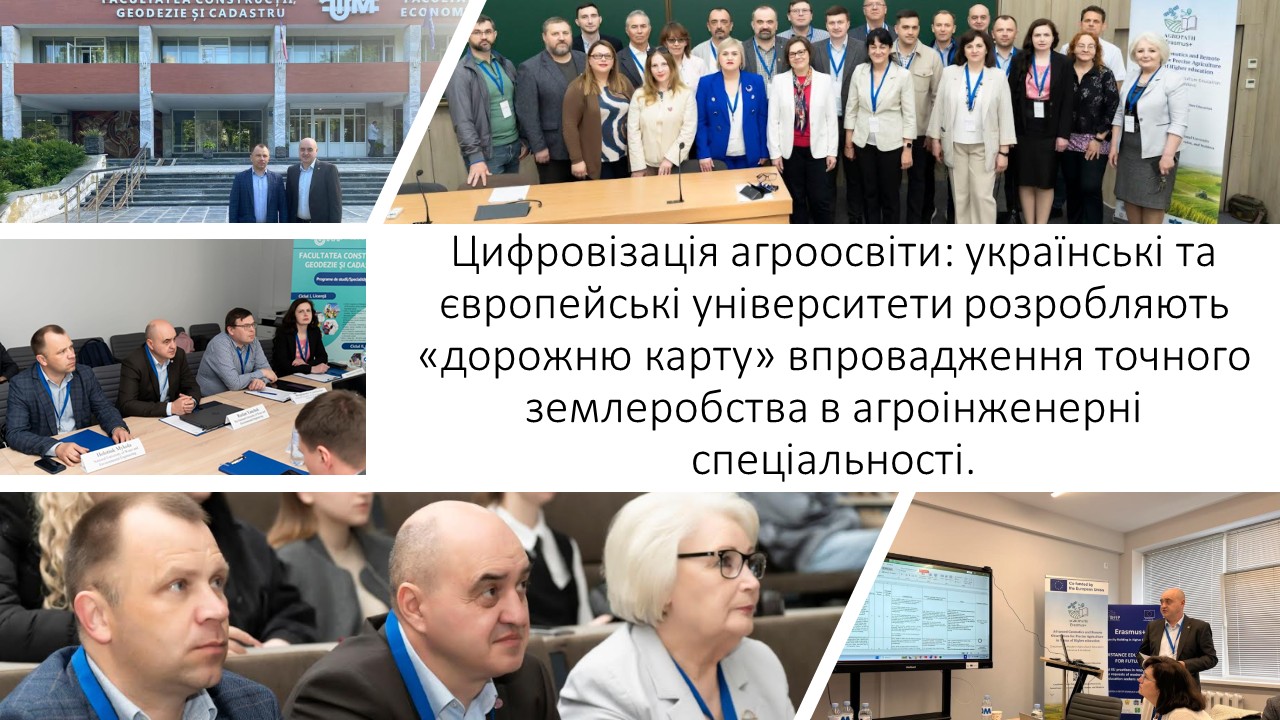
From May 12 to 17, 2026, working sessions of the international workshop 'Peculiarities of Modern Precise Agriculture Curriculum' took place at the Faculty of Construction, Geodesy, and Cadastre of the Technical University of Moldova (Chișinău). The event was part of the large-scale Erasmus+ CBHE AGROPATH project ('Observation for Precision Agriculture in Higher Education').
The project has brought together leading institutions of higher education from Ukraine, Poland, Slovenia, Greece, Hungary, and Moldova.
NUWGP is one of the project partners. NUWGP was represented at the workshop by Ruslan Yanchuk – head of the department of geodesy and cartography – project coordinator from NUWGP and Mykola Holotyuk – associate professor of agricultural engineering – guarantor of the OPP in the specialty 'Agricultural Engineering.'
The main goal of the meeting was to work on the next work package (Work Package 2) and coordinate actions regarding the update of educational programs in the fields of precision agriculture, geomatics, and digital agrotechnologies. Participants conducted a detailed comparative analysis of existing training programs and syllabi, taking into account the requirements of national legislation and the real needs of the modern labor market. As a result of the discussions, a specific list of disciplines and modules to be modernized or created from scratch was agreed upon.
The key focus of the program updates: the integration of the latest remote sensing technologies, geographic information systems (GIS), global navigation satellite systems (GNSS), and the use of unmanned aerial vehicles (UAVs) into the educational process for the specialties 'Agricultural Engineering' and 'Agronomy'.
In addition to preparing students, the workshop emphasized the importance of creating short-term courses. They will be aimed at practicing educators, industry specialists, and representatives of the agricultural business who need rapid upskilling in the field of digital transformation.
During the final sessions, partners analyzed the project's communication strategy, identified potential risks for the implementation of the second work package (WP2), and developed measures for their minimization.
The main practical outcome of the meeting was the approval of the project's 'roadmap', a clear distribution of responsibilities among universities, and the agreement on the schedule for the next stages.
The participation of Ukrainian universities in the Erasmus+ AGROPATH project opens new horizons for international academic cooperation and will allow the training of highly qualified specialists according to advanced European standards, ensuring innovative development of the Ukrainian agro-sector.
Mykola Holotyuk
Associate Professor of Agroengineering Department