The site is currently undergoing maintenance. We apologize for the inconvenience.


- Home
-
For students
- Class schedule
- Class Schedule
- Employment
- Student self-government
- Student Organizations
- Student Committee
- Elective Courses
- Instructions
- Campus Building Plan
- Non-formal education
- Student Science
- Practice
- Department of Military Training
- Tuition and dormitory fees
- Moodle educational platform
- Instructions
- PS - Performance Journal
- For applicants
- Activities
- About NUWEE
MARCH 21 – INTERNATIONAL DAY OF PERSONS WITH DOWN SYNDROME
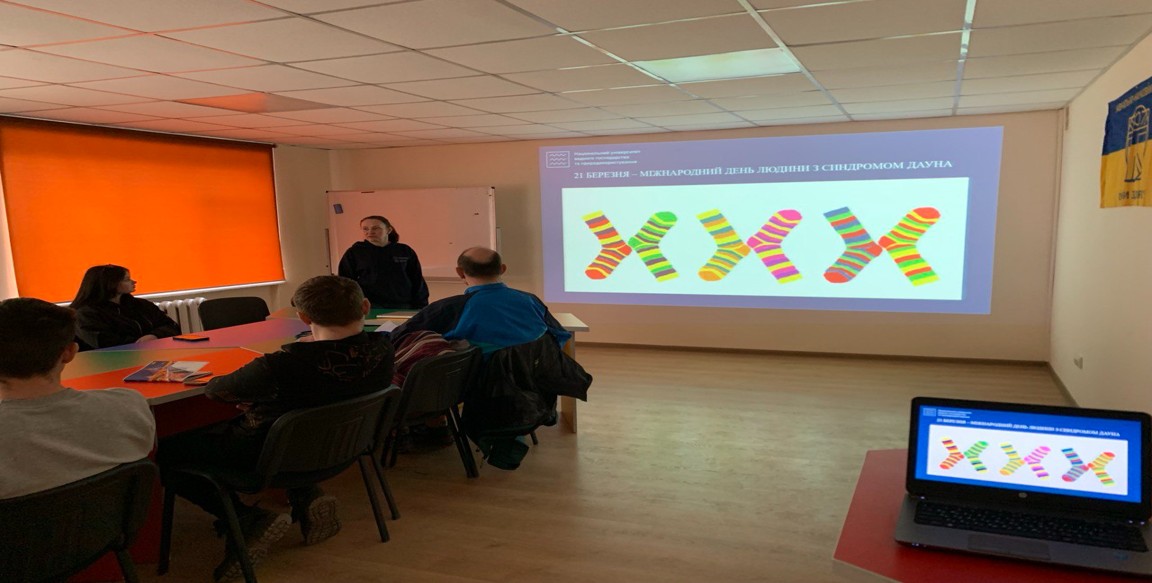
On March 21, the International Day of People with Down Syndrome is celebrated worldwide.
The date is not chosen by chance – it symbolically represents the syndrome itself, which is caused bytrisomy(March is the third month of the year) of the 21st chromosome (hence March 21).
According to statistics, 1 in every 800-1000 infants is born with Down syndrome. Every year in Ukraine, between 300 and 400 such babies are born.
Down syndrome is the most common genetic deviation; it is due to the unusual development of the body because of the presence of an extra 21st chromosome.
This extra chromosome is what makes all affected individuals look similar to each other: slanted eyes with skin folds on the inner side, muscle hypotonia, flat nasal bridge, protruding tongue (a result of a small oral cavity), short neck, white spots on the cornea, excessive joint flexibility, wide feet, short fingers, small low-set ears, and an excessive gap between the first and second toes. Most importantly, a child with this disorder develops noticeably slower than their peers.
Children with Down syndrome indeed find it harder to develop than their typically developing peers. However, with family support and assistance from specialists, they can, like all children, learn to walk and talk, read and write, draw and ride a bike, engage in music or sports, and attend kindergarten and school. They can also make friends, have passions, fall in love, be happy, and make others happy.
It is much harder for them to learn, but everything they know and can do is the hard work of them and their parents! They have the right to education and to realize themselves in society!
To draw attention todiversity, yet equal worth, people with Down syndrome around the world will participate in the event “LOTS OF SOCKS”.
Joining it is simple: you just need to wear colorful, mismatched, or simply bright socks. This way, you will demonstrate your solidarity with people with an odd chromosome, while also attracting the attention of passersby, and understand what it's like– to be different from the majority.