The site is currently undergoing maintenance. We apologize for the inconvenience.


- Home
-
For students
- Class schedule
- Class Schedule
- Employment
- Student self-government
- Student Organizations
- Student Committee
- Elective Courses
- Instructions
- Campus Building Plan
- Non-formal education
- Student Science
- Practice
- Department of Military Training
- Tuition and dormitory fees
- Moodle educational platform
- Instructions
- PS - Performance Journal
- For applicants
- Activities
- About NUWEE
Practice that transforms theory into experience: how students of the Department of Management and Public Administration learn.
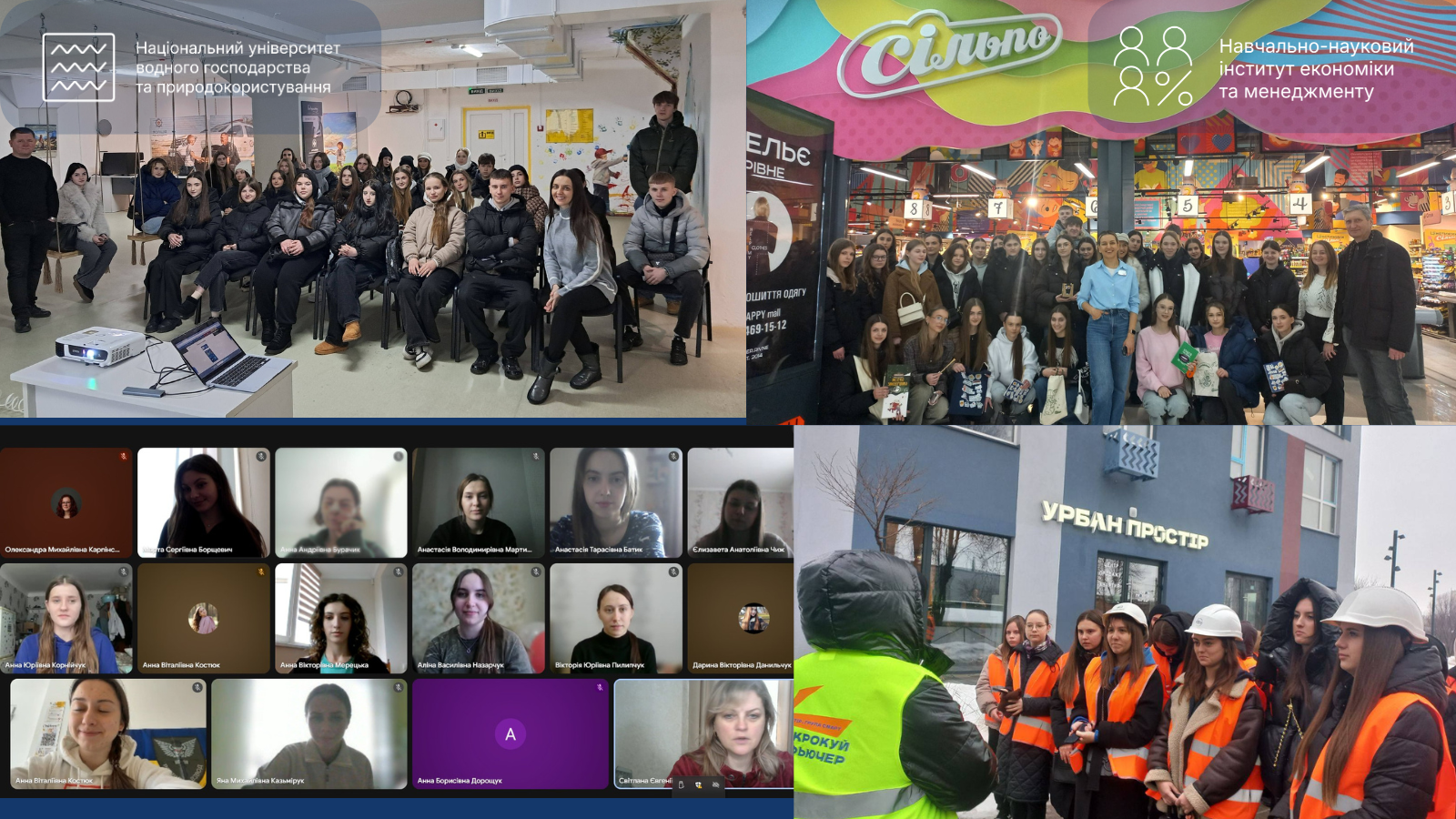
Practice is the moment when a student stops being just a listener of lectures and becomes a participant in real professional processes. This is how practical training takes place at the Department of Management and Public Administration, where education is combined with work at enterprises, participation in training sessions, and the implementation of real projects.
In the 2025-2026 academic year, undergraduate students from three specialties – 'Management', 'Public Administration and Administration', and 'Information, Library, and Archive Studies' – had the opportunity to dive into the work of businesses, government bodies, and information institutions, working on practical tasks alongside representatives of leading companies and organizations.
Management: from getting to know business to creating one's own project
For students specializing in 'Management', practice became an opportunity to see how modern business and organizational management operate. Already from
the first year, they visit enterprises and institutions in Rivne region, getting acquainted with various management models.
As part of the training and workshop practice, students visited a number of enterprises and organizations, including Smart Group, 'Urban Space Zig Zag', PP 'Vilis', the gallery of the public association 'Center for Digital History', shopping centers 'Silpo' (Happy Mall and 'Oksamit'), Rivne Regional Clinical Hospital named after Yuriy Semenyuk, Rivne Regional Children's Hospital, furniture salons 'Dubok' and 'Furniture Warehouse', the Center for Providing Administrative Services in Rivne, the City House of Culture, GC 'Avtograd', UKI Business School, private manufacturing and trading firm 'Violet', as well as the football club 'Veres'.
A feature of practical training is that students can independently shape their format of practice: necessarily working at an enterprise, and additionally choosing to participate in training sessions, educational courses, or the implementation of their own
project.
One of the most interesting parts of the practice is working in the training and workshop laboratory of the Western Business Center of NUWGP. Here, students work with a business simulator and effectively manage a virtual enterprise. Participants perform the roles of director, heads of finance, marketing, logistics, and personnel management, organize meetings, make management decisions, and coordinate the team's work.
This year, students worked on the development of a virtual enterprise, the café 'Pinna Panna', where over two weeks they learned to plan work, delegate tasks, and analyze performance results. The outcome of the practice was the preparation of a business plan in accordance with the requirements of the state entrepreneurship support program '5-7-9'.https://www.facebook.com/share/g/1L6rUDCwNu/
In addition, in collaboration with the Smart People Business School and the United Nations Development Programme (UNDP) in Ukraine, a series of
training sessions with representatives of leading companies was organized for students. In particular, meetings were held with the head of the 'Furniture Warehouse' network, Oksana Osmirko,
territorial manager of the 'Dubok' network Maria Nazar, HR manager of the international company 'Verallia Ukraine' Anastasia Zubenko, and
also the communications manager of the company 'Molokia' Yelizaveta Khrustalova.
Students also participated in trainings within the UNDP project 'Support for Inclusive Recovery to Ensure the Resilience and Safety
of people in Ukraine,' where they learned the basics of starting a business, business planning, and strategic enterprise development.
Public Administration: introduction to the work of government bodies
Students of the 'Public Administration' specialty underwent practical training at state government bodies, local self-government, and non-governmental organizations.
The practice bases included departments of the Rivne Regional State Administration, the executive committee of the Rivne City Council, and Centers for providing
administrative services in the cities of Rivne and Dubrovytsia, as well as Klesiv, Klevan, Stepanske, and Mizytska village councils.
Some students interned at NGOs 'Rivne Together' and 'Intonation of Changes,' where they had the opportunity to participate in the implementation
of social and public initiatives.
During the internship, students became acquainted with the organization of management processes, participated in the preparation of official documents, analyzed
managerial decisions, and worked with state registries and document circulation systems. This experience helps to understand how the system of community and state management functions in practice.
Information, Library and Archive Affairs: Modern Approaches to Working with Information
Students majoring in 'Information, Library and Archive Affairs' underwent practical training from January 26 to February 8, 2026. The practice bases included library institutions in the city of Rivne, educational establishments, municipal institutions, and state executive authorities.
The main areas of work for students were document support for organizations' activities and information communications. Most interns were directly involved in the working processes of the institutions, which allowed them to gain real experience working with documents, information resources, and electronic systems.
A distinctive feature of the practice organization was the use of the university's electronic platform, which facilitated the coordination of students' and practice supervisors' work.
As a result of the practice, students prepared presentations where they shared their experiences, identified the advantages and disadvantages of the organization of the practice, and proposed ideas for its improvement. Among the recommendations were a more active implementation of digital technologies in the work of institutions, providing interns with greater independence, and expanding the range of practical tasks.
Experience that shapes future specialists
Practice for students of the Department of Management and Public Administration is not just an academic requirement. It is an opportunity to see their profession from the inside, work with real cases, and gain first professional experience.
The combination of working in companies, collaborating with government bodies, participating in training sessions, and using business simulations creates a modern model of practical training that helps students develop the competencies necessary for a successful career.