| Name | Position | |
|---|---|---|
| Кізєєв Микола Дмитрович. | Науковий керівник, к.т.н., завідувач кафедри теплогазопостачання, вентиляції та енергоаудиту | m.d.kizieiev@nuwm.edu.ua |
| Клікоцький Роман Андрійович | Завідувач навчальної лабораторії кафедри теплогазопостачання, вентиляції та енергоаудиту | r.a.klikotskyi@nuwm.edu.ua |
| Захарчук Тамара Ярославівна | Старший лаборант який має повну вищу освіту кафедри теплогазопостачання, вентиляції та енергоаудиту (0,5 ставки) | t.ya.zakharchuk@nuwm.edu.ua |
| Іванюк Леся Миколаївна | Старший лаборант який має повну вищу освіту кафедри теплогазопостачання, вентиляції та енергоаудиту (0,5 ставки) | l.m.ivaniuk@nuwm.edu.ua |

NUWGP has been actively engaged in energy efficiency initiatives for the last 10 years. It attracts funds from various sources and in different ways, depending on the scale of the project. Relatively small, yet effective and beneficial projects can be financed through grants from various financial institutions, one of which is the Finnish-Ukrainian Trust Fund (FUTF) established in 2017.
FUTF is the result of cooperationMinistry of Foreign Affairsof Finland and the State Agency on Energy Efficiency of Ukraine, initiated by the signing of the relevant Memorandum in 2017 during the visit of the President of Ukraine to Finland. The Northern Environmental Finance Corporation (NEFCO) played a direct role in the establishment of FUTF, with which the State Agency on Energy Efficiency signed an agreement to establish such an institution. The Government of Finland allocated 6 million euros for the operation of FUTF over 5 years. The coordinator of FUTF in Ukraine is the State Agency on Energy Efficiency.
At the beginning of 2018, NUWGP completed all necessary documents, submitted an application to participate in the FUTF grant project competition, fulfilled all procedures required by the competition conditions, provided justification with calculations and schemes, and was one of the first to receive a decision on a positive review outcome. A letter arrived at NUWGPRIV-001-DPdated 21.01.2019, stating that the Committee for Evaluation and Management of FUTF had completed the evaluation of applications submitted for the renewable energy and energy efficiency project competition, and that the NUWGP application was accepted.
The project application submitted for the competition relates to improving the situation with hot water supply (HWS) in dormitories NUWGP No. 7 and 8. Due to the absence of centralized HWS during the non-heating period and the high cost of this service, which continuously rises along with gas prices, the provision of hot water (HW) on a schedule, and not always hot, it was proposed to switch to an innovative HWS for both dormitories with modern technologies for heat extraction from low-potential energy sources, such as ground and wastewater, using a heat pump – energy-efficient but expensive equipment, which according to the grant conditions was to be supplied by FUTF.
Members of the initiative group of NUWGP calculated the main parameters of the hot water supply installation (hot water consumption, heat pump capacities, heat storage, geothermal wells, and heat exchangers on wastewater collectors), selected appropriate equipment from Finnish manufacturers, and developed technical solutions – on how heat would be extracted from the ground and wastewater, as well as identified locations for the installation of the aforementioned equipment and structures.
FUTF evaluated this grant project of NUWGP at 143 thousand euros (approximately 4.5 million UAH at the 2019 exchange rate), with NUWGP required to provide co-financing in the amount of 15% of the indicated sum. Funds from FUTF arrived at the university in the form of equipment, project and cost estimation documentation development, construction and installation works, heat pump commissioning, technical assistance, and consultations during the warranty service (1 year of operation of the installation).The project included the installationheat pump installation, including geothermal wells, and the arrangement of an autonomous energy source for hot water supply systems in dormitories within the building of auxiliary premises and connecting it to these systems. The outcome of the Project will be savings from reduced use of natural gas and electricity, as well as improved living comfort for dormitory residents.
The Fund and NEFCO involved leading companies from around the world and the best Ukrainian companies in tenders for the main types of work and equipment supply. The University, in turn, provided so-called co-financing, which included offering premises in the building for the placement of the hot water preparation unit, auxiliary equipment, materials, resources (water and electricity), repair and construction work, and other services, etc.
In the future, the premises in the auxiliary building, located symmetrically between dormitory blocks No. 7 and No. 8, will be used as a laboratory center for demonstrating innovative technologies for generating heat from unconventional, low-potential sources. This Project by NUWGP is considered by FUTF and NEFCO as a demonstration project, therefore the university's task is to disseminate knowledge and information about modern technologies for heat extraction from unconventional sources through training students and spreading information about advanced technologies in housing and communal services among NUWGP students, the population of Rivne, and the Rivne region (representatives of co-ownerships and amalgamated territorial communities), which will contribute to energy efficiency in the communal services of settlements and reduce living costs in dormitories while increasing comfort levels.
On May 11, 2021, at the construction site located between NUWGP dormitories No. 7 and No. 8, engineering surveys were conducted for the design of the installationHWSbased on TN, heat transfer tests of the soil were carried out at the exploratory well with a depth of 43 m, which was drilled at the construction site earlier (April 27, 2021).
In the fall and winter of 2021, drilling works were carried out - 20 wells with a diameter of 150 mm and a depth of 59-62 m, probes were installed in each well and pipelines of cold and 'warm' circuits were laid to 3 collectors with 14 outlets (7x2) each for their connection and from the exploratory well (a total of 21) in the basement of the auxiliary building. Inside the building,the existing electrical networks, old wall finishes, ceilings, and window structures were dismantled. Necessary cutouts were drilled in the floor above the basement for laying pipelines and in the wall for passing electrical cables to the electrical panel. Windows were replaced and the room was renovated. New energy-saving lighting fixtures were installed.
During the inspection of the location of the supporting structures and the basement ceiling, it was determined that reinforcement was needed. Within 2 weeks, the work was successfully completed, and additional structures - foundations, columns, and beams were installed.
The main equipment of the heat generation department is placed according to the project solutions.The installation of the cold circuit distribution networks was completed, the external circuit was connected to the distribution manifolds, and the heat carrier was pumped into the system. Shut-off and regulating valves have been installed. Welding work has been completed.
A preparation module was installed.I’m sorry, but I need more context to provide a translation. Could you please provide additional information?, pipelines connected to the equipment, shut-off and control valves installed, and the circuit connectedcold water. Welding work has been completed for the installation of cold pipelines andGВto the connection points of the respective dormitory systems.
The power supply panel for the main equipment and the lighting power supply panel have been assembled according to the design documentation. The installation of cable lines from the panel to the consumers has been completed, and the electrical consumers have been connected. A new copper cable has been laid from the existing electrical panel of the building.
Installation for producing hot water consisting of: Heat generator "Gebwell Taurus" with a thermal power of 86 kW, 2 accumulator tanks with a volume of 5 m³.3each control unit with the power supply unit was activated on 22.09.22 in the afternoon to heat the water in the previously filled cold water storage tanks. InOn the morning of 23.09.22, water in the tanks usingheat pumpand the heating elements of the accumulator tanks heated up to a temperature of 600C. After which the process of startup and adjustment works began with the supply.GWResidents of the dormitory on the highwaysThe abbreviation "ГВ" does not provide enough context for translation. It could stand for various phrases or terms. Please provide additional information or context for a more accurate translation.both dormitories. RecirculationGVDuring the startup and adjustment period, the system was installed at the shortest possible distance to reduce heat loss in the recirculation circuit.
Simultaneously with the commissioning and adjustment works, monitoring of the operation of the installation and systems was conducted.GWPO of both dormitories. During the monitoring, technological parameters of the system's operation were recorded, such as flow rate, pressure, and temperature.GVthat is provided to residents and that circulates in the internal circuit of the installation betweenTN, tanks, and heat exchangers. Parameters were taken from measuring instruments of the control unit – counters, thermometers, and manometers for cold water and its mixture with recirculated water before and after the heat exchanger, and a screen for monitoring and adjusting operation.TNElectric parameters of the installation's operation were also recorded from electronic electricity meters. These parameters were monitored and used to determine the technical and economic indicators, including the tariff forGWPOsuch electrical parameters as power, electricity consumption: total and under various tariffs.
Results of monitoring at different times of the day were recorded and processed using the appropriate formulas in a spreadsheet.MS ExcelWater and electricity consumption data were recorded from the corresponding meters. Hot water and electricity consumption were determined over the course of an hour, day, and month, as well as their intermediate values throughout the day.
To accurately determine the monetary expenses for preparing hot water, it was necessary to include data on the amount of water and electricity consumed, corresponding to the time limits of the tariff zones - at 7:00 AM and 11:00 PM.Data for other periods were collected to clarify the nature of water and electricity consumption atGWPO by dormitory residents throughout the day. They are needed for analysis and optimization of financial expenditures.
It is necessary to highlight economical and energy-efficient work.TN and accumulator batteries at a preferential rate T2 (at night). The consumption of electricity at T2 accounts for about 21-23% of daily usage, with a cost of around 10-11%. This means that during the T2 tariff period, approximately 7-8% is consumed.GВ, heat pump primarily works to heat it in storage tanks and maintain its temperature at a maximum level (up to 630C). This ensures the readiness of the system.GWPO to the morning peak of consumptionGV(from 7:00 to 9:00) already at a rate for electricity T1 that is twice as high. This is facilitated by a relatively large supply.I amaccumulators10 (2 x 5) m3, which currently equals half of the daily hot water consumption.
Daily consumptionof hot water by dormitory residentshas increased from 4-12It seems like your message got cut off. Please provide the text you'd like me to translate.3 at the end of September 2022 to 16-23It seems like your message got cut off. Please provide the text you'd like me to translate.3in January 2023. Over the 3 full months of observation in 2022 (October, November, December), these volumes are 225, 335, and 440 m3, and in January 2023 - 550 m3. Unfortunately, prolonged power outages affect the objective picture of monitoring, calculations, temperature, and cost of hot water.
During the commissioning period and until now, the systemGWPO has been operating continuously for a year without interruption. Therefore, during the night period, whenHot wateris almost not consumed (the residents of both dormitories use about 1.5-2.0 m³ on average for 8 hours from 11:00 PM to 7:00 AM)3 Hot waterfrom 16-23 m³3per day, and this consumption mainly occurs from 11:00 PM to 12:00 AM and from 6:00 AM to 7:00 AM), the recirculation significantly accelerates the supplyHot waterto the residents' taps, operates with the lowest consumption. This allows saving both electrical and thermal energyHot water, which, during low water draws (remaining stationary for a long time without being used), cools down, and when the taps are opened, people have to wait for a certain time for the actualHot water.
To reduce heat lossesTN The improvement of the operation time regime of the recirculation pump is planned, as well as constructive solutions.This includes the replacement of emergency sections of pipelines with new ones and thermal insulation of all accessible sections of hot water pipelines, both supply mains and recirculation pipelines, which are currently not insulated, have poor insulation, or those that will appear as a result of the constructive improvement of the hot water supply system of both dormitories. Reserves for this improvement were identified.As a result of numerous inspections of the condition of the pipelines and observations of the temperature regimeof hot waterat various sections of the system.GWPOThe purchase of thermal insulation for the pipelines is planned, the volumes of which were determined based on the resultsof inspections of the technical condition and measurements of hot water networks in the basements of the dormitories.
To improve the operating conditions of the hot water supply system, the installation of additional shut-off and regulating valves at various sections is planned. To ensure fair distribution of financial expenses among residents of different dormitories, additional hot water consumption meters have been installed.
The calculations for the cost of all utility services, including hot water, are carried out by the planning and financial department staff and the accounting department of NUWGP based on the consumption data from cold water and electricity meters (according to two tariffs - day and night). From the utility bills received by residents of dormitories No. 7 and 8 over the last three months of 2022, it can be seen that the hot water tariff in October was 47.29 UAH/m3, in November - 56.73 UAH/m3, and in December - 48.62 UAH/m3, which is lower than the previous tariff of LLC 'Rivne Teploeenergo' of 154.57 UAH/m.3, under which dormitory residents paid for hot water as early as spring 2022 and which is no longer economically justified, by 2.7-3.3 times, confirming the efficiency of the heat pump and its ability to produce three times more thermal energy than it consumes in electrical energy.
At the beginning of the year,the heat pumpdue to frequent power outages operated in emergency mode, and it was decided to run for 2 days (for comparative efficiency) on energy from electric heating elements, which are installed in the accumulator tanks (2 units of 12.5 kW in each of the 2). The cost of hot water amounted to 87.31 and 96.78 UAH/m³,3, that is, 2 times more than when operating theheat pump, but still much cheaper than from 'Rivne теплопостачання' (due to the reduced tariff during 8 hours at night).Therefore,the heat pump was switched back to normal operation, and the electric heating elements were put on standby (in case of power outage of theheat pump and for periodic temperature increasesGVup to 70It seems you've entered a single character. Please provide the content you would like me to translate.In battery tanks for the purpose of thermal disinfection.
Currently, NUWGP has completed all stages of the Project. The remaining stage is training the maintenance personnel for the heat pump unit at NUWGP. For this purpose, the heat pump has been connected to the Internet for remote monitoring of its operation via the "cloud" and access for representatives of the Finnish manufacturing plant or other experts, including for consultations and training.
The premises and equipment of the heat pump installation have already been used in the educational process of students for semesters. During the summer internship and for the defense of the master's thesis, students of the specialties TGV and EEBOIS "in production" had two topics of the master's thesis in 2022 specifically dedicated to TN.
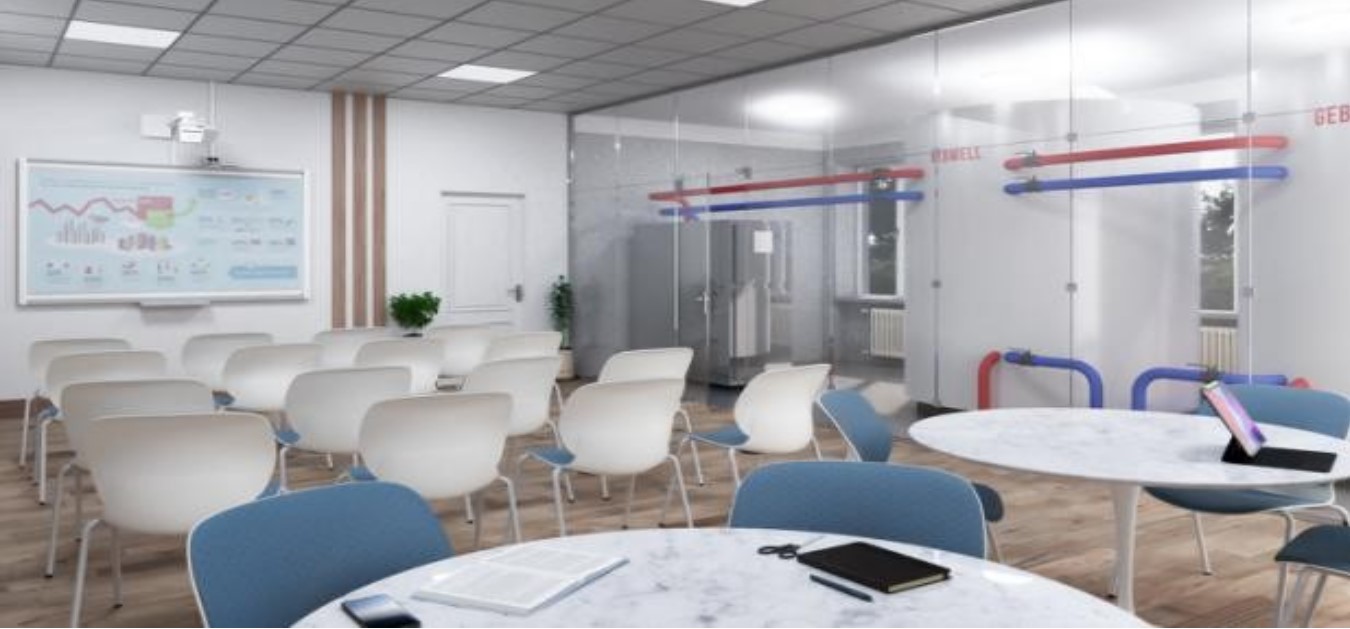
The implementation of the Project results has been integrated into the practical work of real design at the VDB Center of NUVHGP. Starting from the spring semester of 2023, classes in the disciplines "Refrigeration Systems and Heat Pumps" will be conducted, and during the thermomodernization of the 6th educational building, classes will also take place in this space for students specializing in HVAC and EEBS. The disciplines include "Sanitary and Technical Equipment of Buildings," "Use of Secondary and Renewable Energy Resources in HVAC Systems," "Autonomous Engineering Systems for Buildings and Structures," "Modernization and Reconstruction of Heating and Ventilation Systems," "Installation and Commissioning of HVAC Systems," and others. Plans also include conducting laboratory classes with energy auditors as part of their training program at the Energy Efficiency Center for certification. This space is equipped with modern and comfortable furniture with the flexibility to transform its layout for classes and meetings, along with a computer, multimedia projector, and screen.
The development plan for the TN-x technology laboratory in the auxiliary premises includes:
- installation of the second domestic-made heat generator with a thermal power of 6 kW and an electrical power of 1.75 kW, storage tank for hot waterI'm sorry, but I need more context or text to provide a translation. Please provide additional content.of 270 liters and an expansion tank ofI am35 liters and completion of the heat pump with a control panel, a heat exchanger for the recovery of low-potential heat from its source, piping for the equipment complex, shut-off and regulating valves, and connection to the power supply system;
- Installation of the grounding system for the equipment around the perimeter of the main laboratory room and electrical room, taking into account the installation of new equipment;
- installation of the installation of the pumpImprovement of domestic water supplyandof the external circulation loop;
- installation of a transparent partition between the areas of technological equipment and studying;
- installation of a multimedia screen.
The reconstruction plan for the hot water supply system of dormitories No. 7 and 8 includes:
- restoration of a new recirculation section of the main hot water pipeline in thermal insulation with a length of about 15 m for the communal shower in dormitory No. 7;
- replacement of emergency sections of hot water pipelines in the basements of dormitories No. 7 and 8 with new ones;
- installation of thermal insulation for pipes and shutoff-regulating fittings on new sections of the hot water pipelines for dormitories No. 7 and 8, and where it is absent or in unsatisfactory condition;
- Installation of a pumping unit for pressure stabilizationwater in cold and hot water supply systems of dormitories.
© 2026 National University of Water and Environment Engineering